The Illusion
The Dark Room
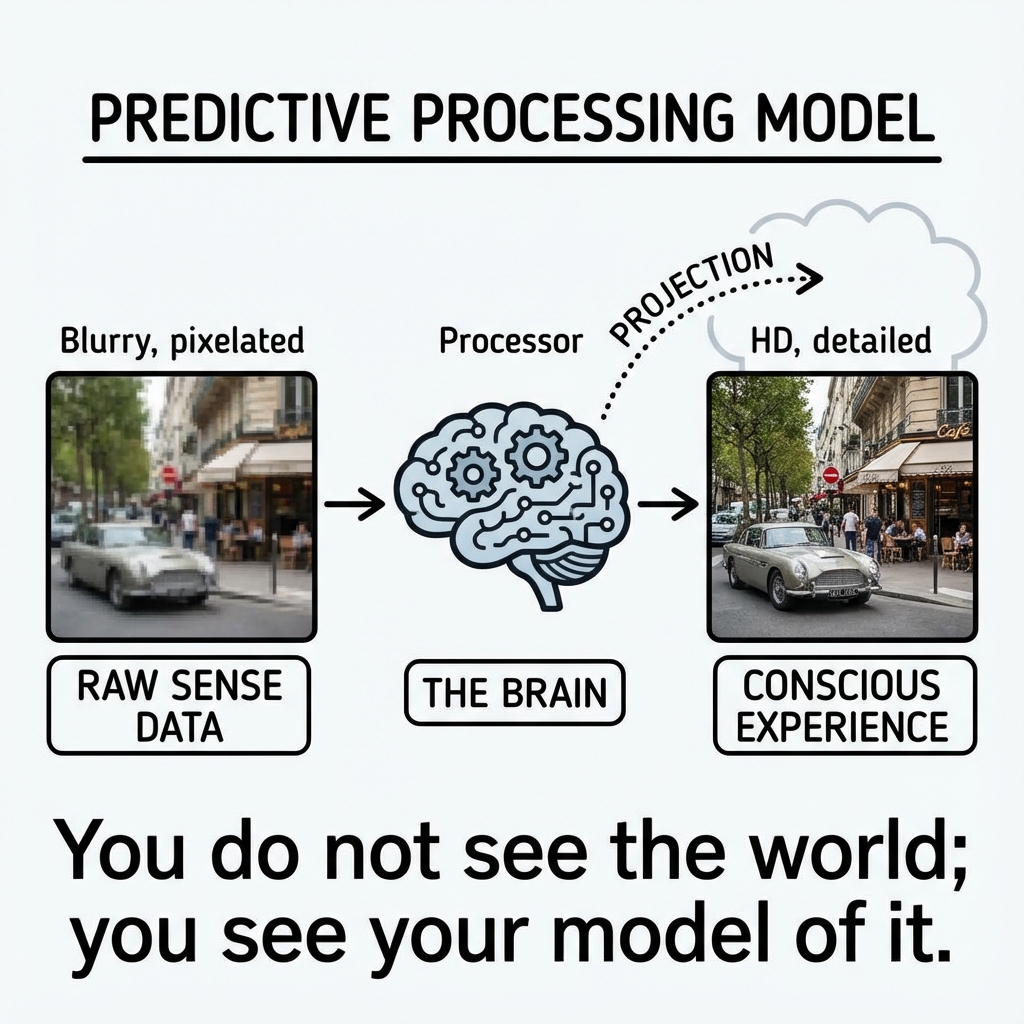
Your brain has never seen the sun. It has never touched a tree. It sits in a pitch-black, silent vault of bone (the skull), floating in fluid.
All it receives are electrical spikes from the eyes and ears.
From these sparse signals, it constructs a Technicolor, 3D world in real-time.
This construction is not a recording of what is "out there." It is a Prediction.
Neuroscience axiom: You do not see with your eyes; you see with your brain.Controlled Hallucination
Anil Seth (University of Sussex) calls this "Controlled Hallucination."
- Hallucination: Perception without sensation.
- Perception: Hallucination controlled by sensation.
When you dream, the sensory input is cut off, so the hallucination runs wild.
When you are awake, the sensory input (photon hitting the retina) acts as a constraint, tethering your hallucination to the physical world. But it is still a hallucination.
Interface Theory
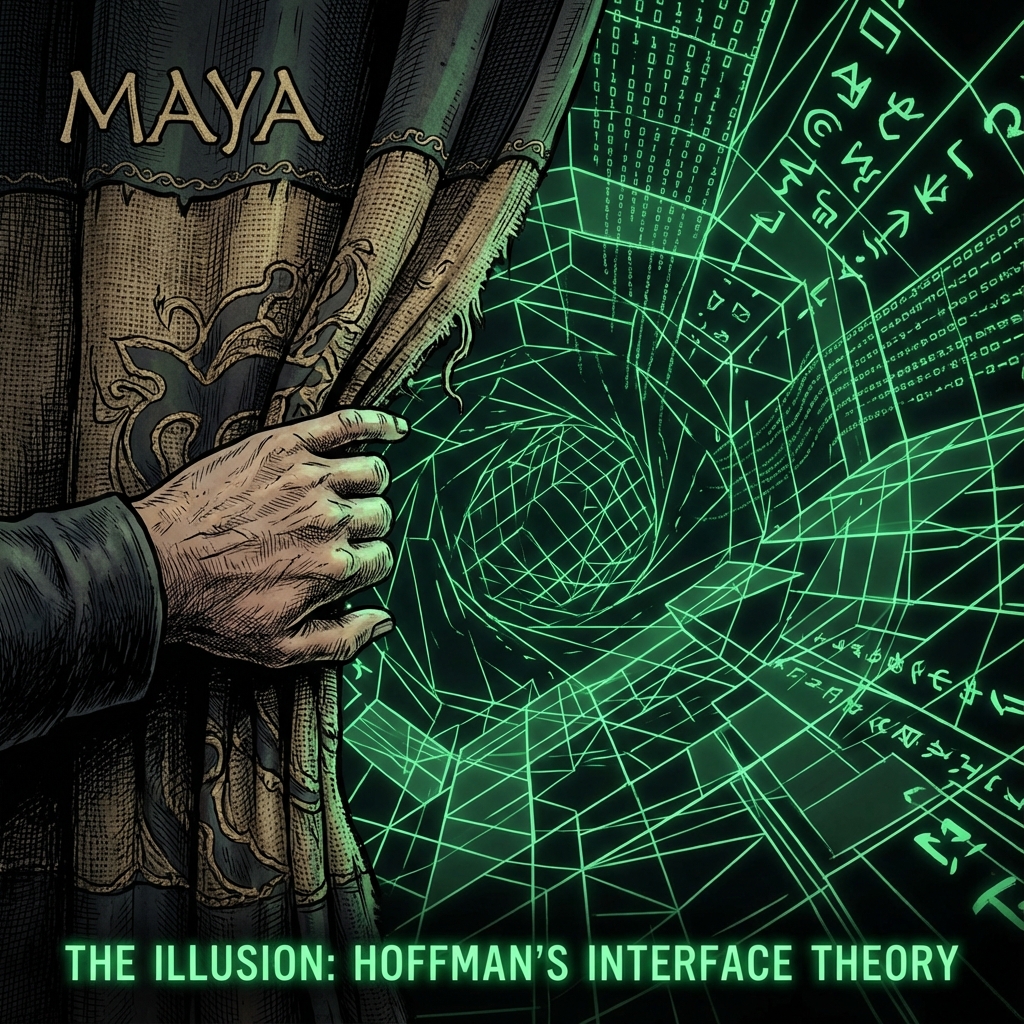
Donald Hoffman (UC Irvine) takes it further. He proves mathematically that evolution does not select for truth. It selects for fitness.
To survive, you don't need to know the truth (e.g., the complex code of a file); you just need an interface (the Trash Bin icon).
Space and Time are not fundamental realities. They are the desktop interface of our species.
If you saw reality as it actually is (Quantum Fields), you would be paralyzed by the complexity. You would die.
Maya is not a curse; it is a survival mechanism.
The Inheritance of Perspective
The "Self" you think you are is just another icon on the desktop. It is a useful fiction for social navigation, but it has no more reality than the cursor on your screen.
---
[!NOTE]
Clinical Context: The Umwelt
>
1. Species Specificity: A bat "sees" via sonar. A tick "sees" via heat and butyric acid. Each species lives in its own sensory bubble called an Umwelt.
2. Color: Color does not exist in the universe. It is a psychophysical sensation created by the brain to distinguish wavelengths.
3. Humility: Understanding Maya forces intellectual humility. We accept that our strongest convictions are likely just artifacts of our specific operating system.