The Bliss Molecule
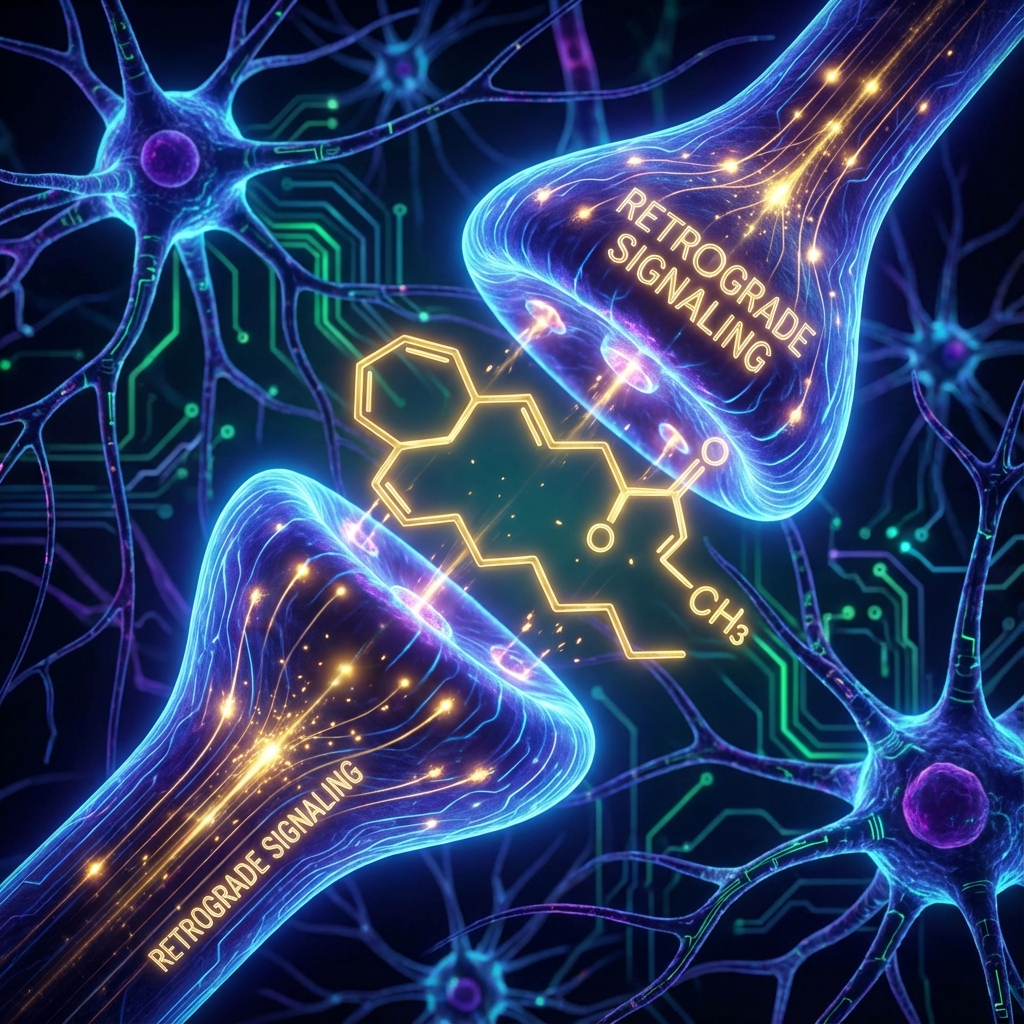
The Lock and Key
For thousands of years, humans used the cannabis plant without knowing why it worked. It wasn't until the 1990s, in search of the receptor that binds THC, that scientists discovered a profound truth: The brain is already making it.
They found the CB1 receptor (Cannabinoid Receptor Type 1), the most abundant G-protein coupled receptor in the brain. If there is a lock, there must be a key. They searched for the endogenous ligand—the body's natural THC. In 1992, Raphael Mechoulam's team found it.
They named it Anandamide.
Derived from the Sanskrit word Ananda—meaning "Bliss."
Retrograde Signaling: The Circuit Breaker
The Endocannabinoid System (ECS) is unique. Most neurotransmission is anterograde: Neuron A fires a signal to Neuron B.
The ECS is retrograde. It travels backward.
When Neuron B is over-stimulated (firing too rapidly), it synthesizes Anandamide on demand. This molecule travels backwards across the synapse to Neuron A, binds to the CB1 receptor, and tells Neuron A: "Quiet down."
It is the brain's Dimmer Switch. It governs homeostasis. It modulates pain, appetite, mood, and memory. Without this "forgetting" signal, the brain would be overwhelmed by noise.
"To remember is human; to forget is divine."
— The function of the ECS is largely to allow us to move on from the past.
THC vs. Anandamide
Here lies the mechanism of the "high."
Anandamide is a fragile molecule. It is created instantly and destroyed instantly by the enzyme FAAH. It is a precise, localized whisper. THC (Tetrahydrocannabinol) is a sledgehammer. It looks like Anandamide, so it fits the CB1 lock. But it resists FAAH decomposition. It doesn't break down quickly. It floods the entire system, binding to receptors in the hippocampus (memory), amygdala (fear), basal ganglia (motor), and cortex (perception).This flood causes the "High":
1. Time Dilation: The internal clock (regulated by the cerebellum/basal ganglia) slows down.
2. Memory Suppression: The hippocampus stops encoding short-term memory (RAM is cleared).
3. Novelty: With memory suppressed, everything feels "new" and "significant" (Salience modulation).
4. Anxiolysis: The amygdala's fear response is dampened.
The Spiritual Mechanism
Why does this feel spiritual? Because our "Self" is largely a construct of memory and prediction.
By dampening the hippocampus (memory) and the DMN (the autobiographical self), THC temporarily dissolves the narrative. The "I" that worries about the mortgage or the past is silenced by the flood of the agonist.
What remains is Presence.
The user is forced into the Now because the mechanism for projecting into the Future or ruminating on the Past has been chemically inhibited.
This is the biological basis of Samadhi facilitated by the plant. It is not magic; it is the modulation of the temporal binding of consciousness.