Untitled
title: Salience Network
subtitle: The Switchman at the crossroads of attention.
book: Book 2
chapter_id: 15
read_time: 11 min
previous_chapter: ../book2/chapter14_dmn.html
next_chapter: ../book2/chapter16_cen.html
meta_description: The Salience Network and attention switching.
The Toggle
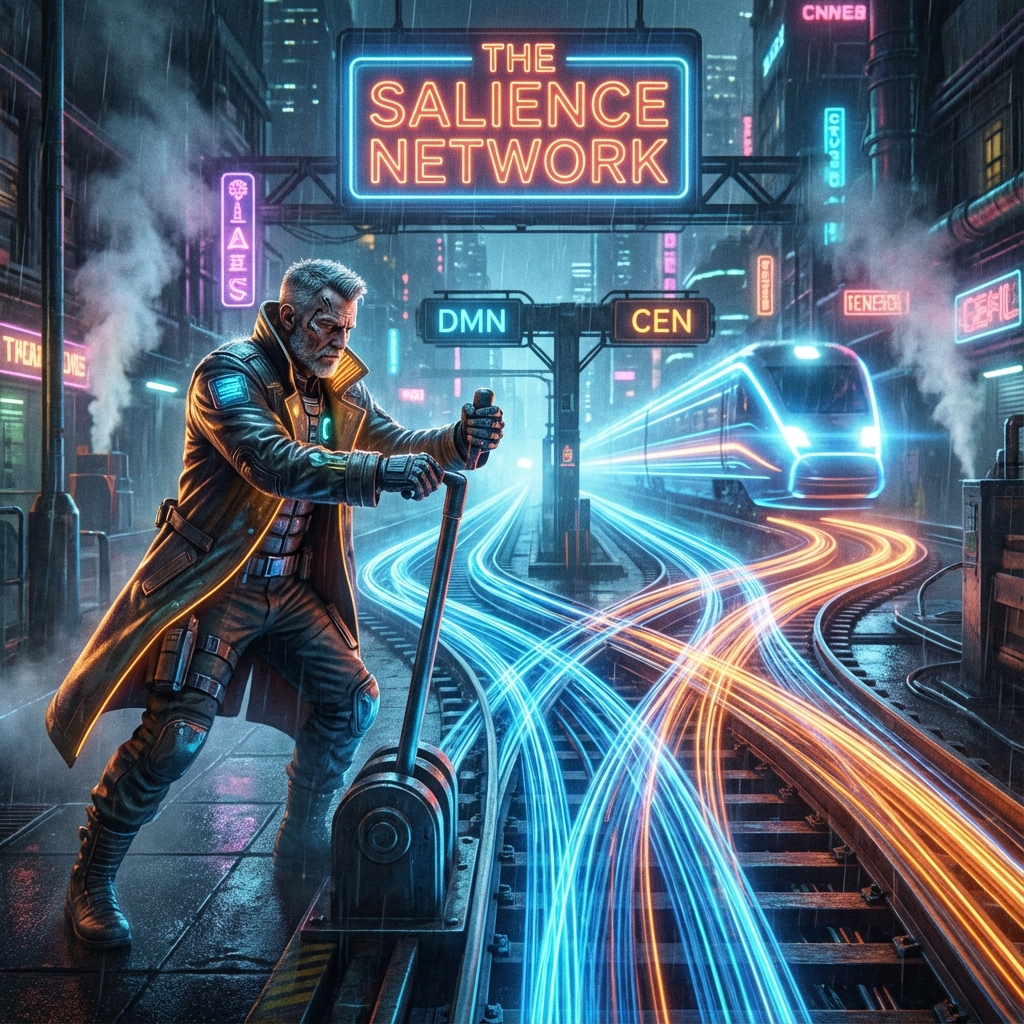
You cannot be in "Internal Thought" (DMN) and "External Focus" (CEN) at the same time. They are anti-correlated networks.
The Salience Network is the switch.
The Anatomy of Importance
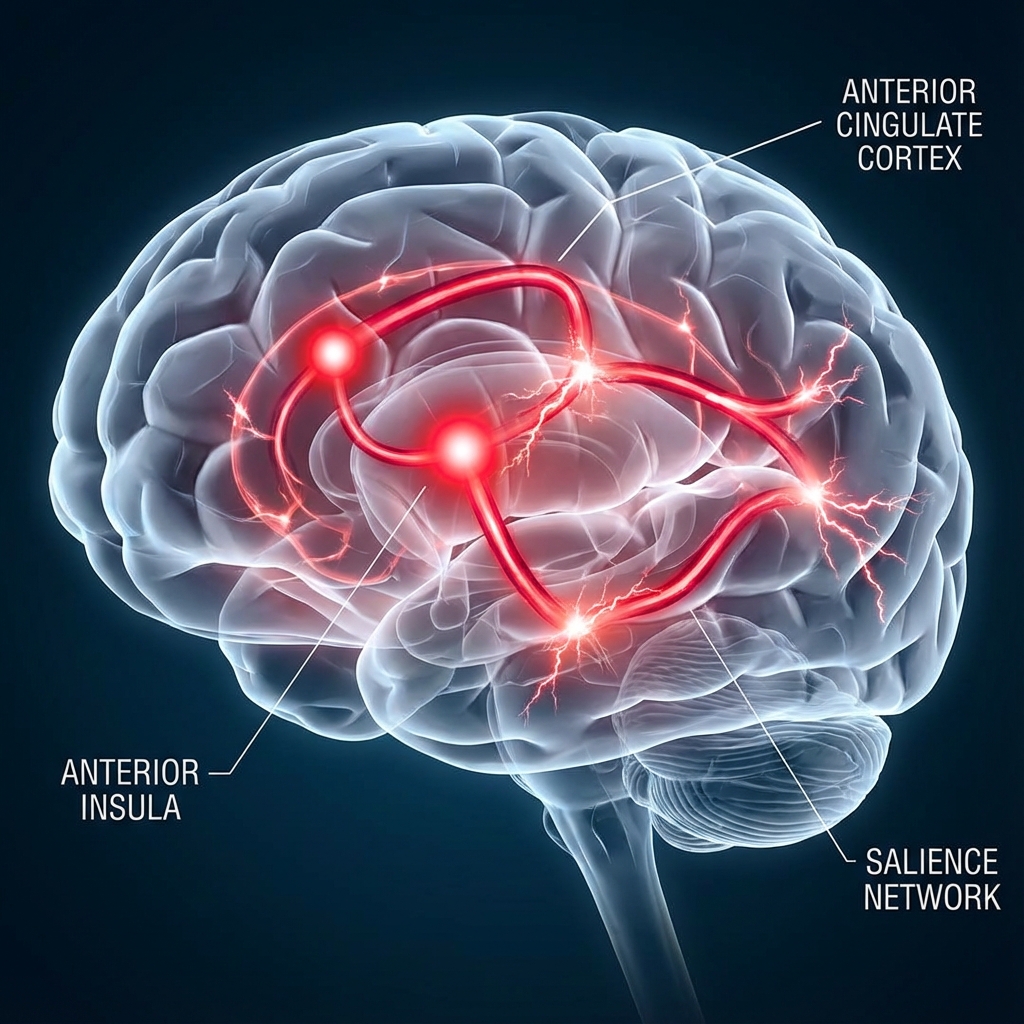
The Salience Network is anchored by two critical nodes:
1. Anterior Insula (AI): The Sensor. It maps the internal state of the body (Interoception). "My heart is racing," "My gut hurts."
2. Dorsal Anterior Cingulate Cortex (dACC): The Actor. It receives the signal from the Insula and commands the brain to shift gears.
The Switching Mechanism
The Salience Network is the "Dynamic Switch" between the internal world (DMN) and the external world (CEN).
- Healthy Switch: Recognizes a threat -> Suppresses DMN (stop daydreaming) -> Activates CEN (solve the problem).
- Broken Switch: Fails to engage CEN. You get the anxiety (Insula) without the solution (PFC). This is the neurological definition of panic.
The Broken Switch
In many disorders (Schizophrenia, Autism, Chronic Pain), the Salience Network is dysregulated. It assigns "importance" to random noise (hallucinations) or harmless signals (hypochondria).
It gets stuck.
The Inheritance of Perspective
Attention is your most valuable currency. The Salience Network decides how you spend it. If you train it to find threat everywhere, you will be poor in peace. If you train it to find opportunity, you will be rich in growth. You condition the switchman by what you choose to stare at.