Integrated Information (IIT)
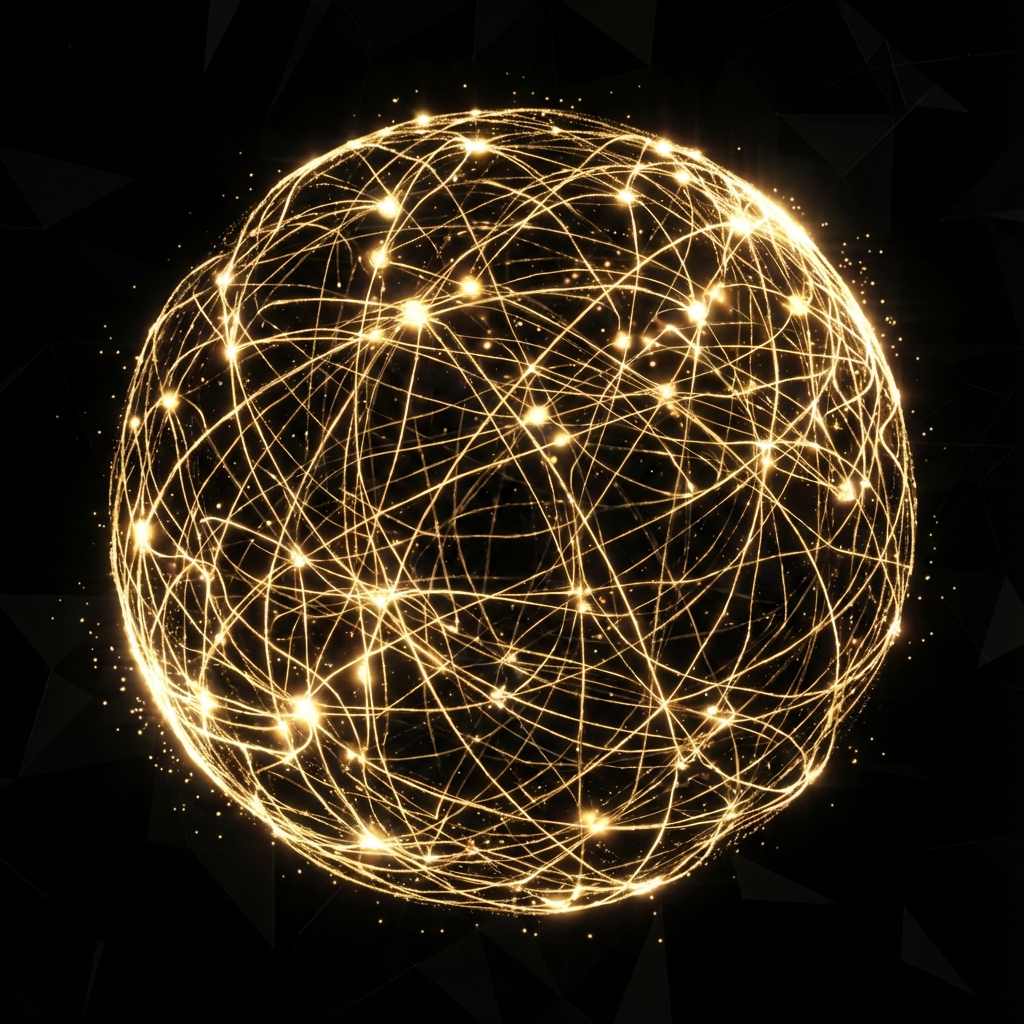
Only the Connected Are Real
How do you measure if something is conscious?
Is a thermostat conscious? It "knows" if it's hot or cold.
Is a supercomputer conscious? It knows all of Wikipedia.
Is a sleeping human conscious? No.
Giulio Tononi, an Italian neuroscientist, proposed a provocative answer: Phi (Φ).
His theory, Integrated Information Theory (IIT), states that consciousness is proportional to the integrated information a system generates. Not just information (a hard drive has that), but information that is irreducible—where the whole is greater than the sum of its parts.
The Mathematical Intuition: What is Φ?
Φ (Phi) quantifies how much a system loses when you partition it.Imagine a brain split in half. You lose consciousness entirely (corpus callosum severing in split-brain patients demonstrates this). The resulting two hemispheres generate far less integrated information than the unified whole.
Now imagine a pile of sand split in half. You just have two smaller piles. Nothing is lost.
Formal Definition (Simplified):Φ measures the irreducibility of cause-effect power across a system's past and future states. It asks: If I partition this system, how much do I lose in terms of the difference it makes to itself?
- High Φ: The system is a unified whole. Every element constrains every other element.
- Low Φ: The system is a collection of independent parts (a photodiode grid, a feedforward neural network).
Why Feedforward Networks Have Low Φ
Your cerebellum (which is mostly feedforward) has minimal Φ despite having ~50% of the brain's neurons. This is why cerebellar damage impairs motor coordination but not consciousness.
Consciousness requires recurrent loops—feedback between cortical layers. The thalamocortical system has high Φ precisely because of these massive reverberation circuits.
Computational Intractability
Critical Caveat: Calculating Φ is computationally intractable for systems larger than ~10-12 neurons. We cannot measure it directly in human brains. IIT makes predictions (e.g., cerebellum has low Φ, cortex has high Φ) that are tested indirectly via perturbational complexity index (PCI) using TMS-EEG.The Photodiode Argument
Why doesn't a camera feel "light"?
When a camera sensor counts photons, Pixel A doesn't know what Pixel B is doing. They are independent. It is a crowd of islands.
In your brain, when you see a face, the neurons coding for "eyes" talk to the neurons coding for "emotion" and "memory." The experience is unified. You don't see shapes + colors + memories; you see Grandma.
That unification—the irreducibility of the experience—is what Φ captures.
Clinical Application: Integration vs. Fragmentation
IMPORTANT CLARIFICATION: IIT does NOT claim that "low Φ = mental illness." Fragmentation is a descriptive observation in certain conditions, not a normative diagnosis.Where Integration Matters:
1. Psychedelics & Network Connectivity:
Research shows psychedelics increase global brain connectivity (Carhart-Harris et al.). Paradoxically, this may decrease local Φ while increasing entropy, leading to "ego dissolution."
2. Dissociative States:
Trauma, dissociation, and certain disorders involve disconnection between memory networks (hippocampus) and executive function (PFC). This is not "low Φ" in IIT's technical sense, but it is functional fragmentation.
3. Stroke & Split-Brain:
Actual physical severing of connections (corpus callosum) creates two separate conscious systems—empirical evidence for integration's role in unified experience.
Ethical Note: We must not conflate IIT's mathematical framework with clinical diagnosis. Autism, schizophrenia, and other neurodivergent conditions are not "low-Φ states." IIT measures a substrate property, not a value judgment.Philosophical Critiques of IIT
IIT is controversial in philosophy of mind. Here are major objections:
1. The Expander Problem (Pautz, Doerig)
IIT predicts that simple grid structures (like digital circuits) can have extremely high Φ. Critics argue this leads to absurd conclusions (a thermostat grid could be more conscious than a monkey).
2. The Unfolding Argument (Searle)
If Φ is all that matters, then you could "unfold" a brain into a feedforward network that produces identical behavior but has zero Φ. This challenges IIT's claim that Φ causes consciousness.
3. Is Φ Measurable?
Since we can't calculate Φ for real brains, is IIT falsifiable? Tononi responds with PCI (Perturbational Complexity), but critics argue this is a proxy, not Φ itself.
IIT is a bold hypothesis, not settled truth. It offers a mathematical formalism for something previously unmeasurable, but it remains one theory among many.The Integration: Re-Connection
In the Cortex Codex, we use the metaphor of integration because it aligns with observation: A brain that cannot talk to itself (trauma isolating memory from safety signals) suffers. Reconnection allows healing.
This is a functional insight, not an IIT validation.
The Panpsychist Implication
IIT is mathematically compatible with panpsychism (Chapter 3). If Φ is the measure of consciousness, then any system with non-zero Φ has some degree of experience—even an electron pair.
Tononi himself has suggested this: consciousness is not an on/off switch, but a continuum from atoms (minuscule Φ) to brains (vast Φ).
The Inheritance of Perspective
System integrity is defined by the degree of information integration (Φ). IIT proposes that consciousness arises from irreducible cause-effect structures within a system. While IIT remains a contested mathematical theory, the concept of Integration is a powerful mental model for health. Fragmentation leads to suffering; connectivity leads to wholeness.
---
[!NOTE]
Clinical Context: Integration vs Fragmentation
While IIT is a mathematical theory, we observe analogous patterns in clinical pathology:
1. Trauma / Dissociation: Often involves functional disconnection between memory networks (Hippocampus) and executive control (PFC).
2. Healing (The Cortex Protocol): Interventions like Psychedelic Therapy or EMDR aim to restore global connectivity ("Re-Integration"), allowing the system to operate as a unified whole.
>
Disclaimer: This uses "Integration" as a clinical metaphor, not a claim that we are measuring the patient's Φ score. Autism/Schizophrenia are not "Low Φ" states.