The Hard Problem
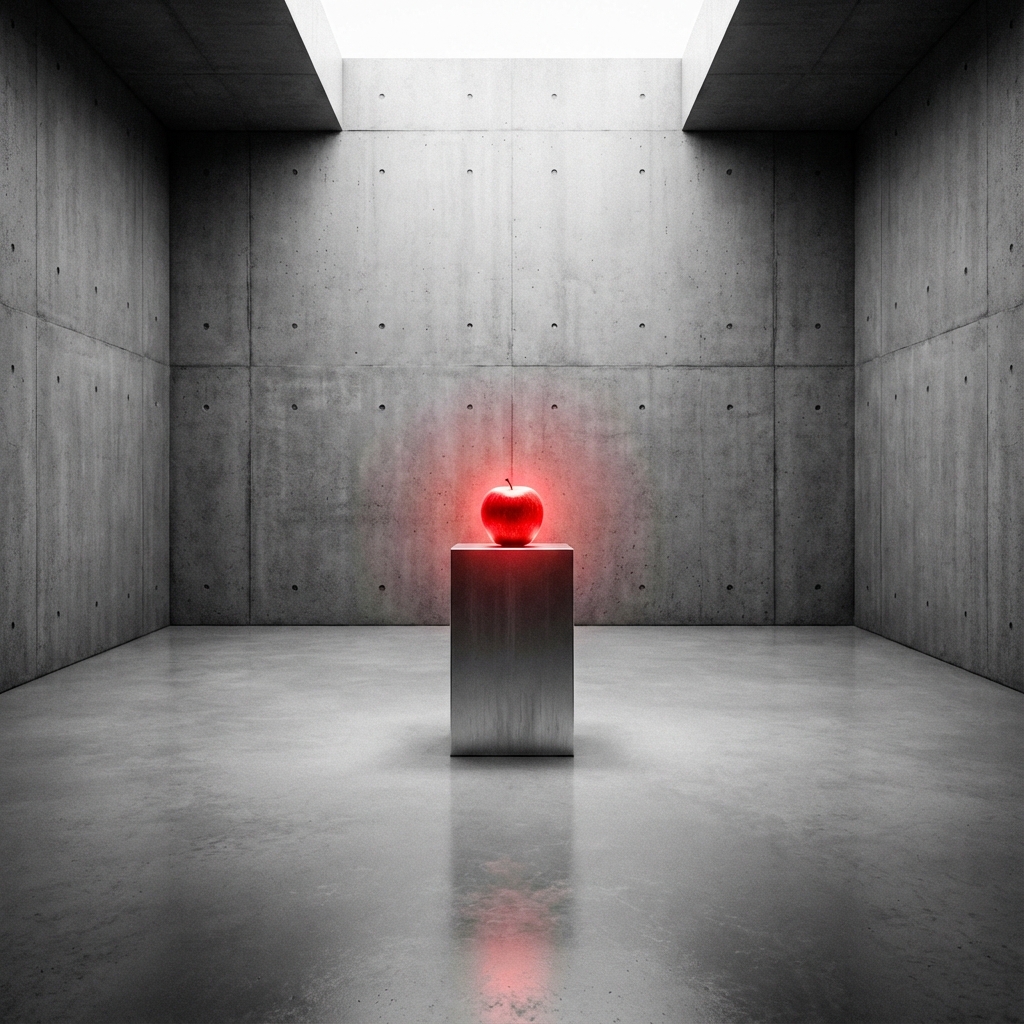
The Zombie Argument
Imagine a being that looks, talks, and acts exactly like you. It processes information. It says "Ouch" when burned.
But inside? Nothing. No redness of red. No pain of pain. Just computation.
This is a Philosophical Zombie.The
question is: Why are you not a zombie? What makes the lights come on?
The Easy vs. The Hard
David Chalmers, an Australian philosopher, divided the problems of consciousness into two categories:
Easy Problems (solvable by neuroscience):- How does the brain integrate information?
- How do we distinguish self from other?
- How do we report mental states?
You can fully explain the function of vision (wavelengths → retina → V1 cortex → object recognition).
But you cannot explain the experience of "blueness." There is an explanatory gap.
Mary's Room
Mary is a scientist who has lived her entire life in a black-and-white room. She knows everything about the physics of color—wavelengths, cone cells, neural pathways.
Then, she steps outside and sees red for the first time.
Question: Did she learn something new?If yes, then Qualia (subjective experience) cannot be reduced to physical information.
If no, then you believe Physicalism is complete (but most people find this absurd).
The Neuroscientific Quest: Neural Correlates of Consciousness (NCC)
While philosophy debates why consciousness exists, neuroscience asks where it happens. Researchers search for the Neural Correlates of Consciousness (NCC)—the minimal neural activity sufficient for a specific conscious experience.
The Posterior Hot Zone
Emerging evidence suggests that the posterior cortex (temporoparietal junction, precuneus, posterior cingulate) is critical for conscious content, while the prefrontal cortex (once thought essential) may only support reporting and introspection, not experience itself.
Experimental Paradigms
Scientists use clever tricks to isolate consciousness from behavior:
- Binocular Rivalry: Present different images to each eye. Your conscious percept alternates, even though the visual input is constant. By tracking neural activity during these flips, we isolate the NCC.
- Masking Studies: A visual stimulus flashed too briefly is "masked" and remains unconscious. Comparing masked (unconscious) vs. unmasked (conscious) trials reveals the neural signature of awareness.
- No-Report Paradigms: To separate access consciousness (what you can report) from phenomenal consciousness (what you experience), researchers use eye-tracking and pupil dilation instead of verbal reports.
Competing Theories: Different Maps to the Same Territory
The Hard Problem remains unsolved, but neuroscientists have proposed frameworks that address the "Easy Problems" while gesturing toward the Hard one:
1. Global Workspace Theory (GWT) – Baars & Dehaene
Consciousness is like a theater stage. Information becomes conscious when it is "broadcast" globally across the brain's workspace, accessible to multiple cognitive systems (memory, planning, language).
- Strength: Explains why conscious information is reportable, flexible, and integrated.
2. Recurrent Processing Theory (RPT) – Lamme
Consciousness arises from recurrent feedback loops between higher and lower cortical areas. Feedforward processing (stimulus → V1 → V4) is unconscious; only when information loops back (V4 → V1) does it become conscious.
- Strength: Explains the timing of consciousness (~200-300ms after stimulus).
- Limitation: Doesn't explain why recurrence generates qualia.
3. Attention Schema Theory (AST) – Graziano
Consciousness is the brain's model of its own attention. Just as the brain builds a body schema (knowing where your limbs are), it builds an "attention schema" to track what it is focusing on. This self-model is consciousness.
- Strength: Explains awareness as a functional control model.
- Limitation: Risks reducing consciousness to an "illusion" (though Graziano disputes this).
4. Integrated Information Theory (IIT) – Tononi
(We will explore this in Chapter 2.)
Important: These theories are competing, not settled science. The NCC remains elusive, and none fully solve the Hard Problem. They map the correlates, not the cause.The Integration: Why This Matters
This is not academic. If consciousness is reducible to computation, then you are just meat running an algorithm. Suffering is an illusion to be debugged.
If consciousness is more than computation, then altering the brain (via drugs, neurostimulation, or surgery) is not just "fixing a broken machine." It is altering Being itself.
We proceed in this Codex with humility: We do not know what consciousness is. We only know how to modulate its conditions. Every intervention—Ketamine, rTMS, psychedelics—operates on the correlates of consciousness. We change the brain and, mysteriously, experience shifts. But the explanatory gap remains.
Ethical Implication: Because we do not fully understand the relationship between brain and mind, we must approach treatment with epistemic humility and deep respect for subjective experience. The patient's first-person report is not "just data"—it is the phenomenon we are trying to heal.The Inheritance of Perspective
The "Hard Problem" is a reminder that subjective experience has an irreducible quality that cannot be fully captured by third-person scientific description. When treating the mind, we are not merely adjusting variables in a system; we are engaging with the lived reality of a conscious being. This demands ethical care and epistemic humility. The search for Neural Correlates of Consciousness (NCC) helps us map the territory, but the map is not the terrain—brain activity is the correlate, not the cause, of the mystery of experience.