Untitled
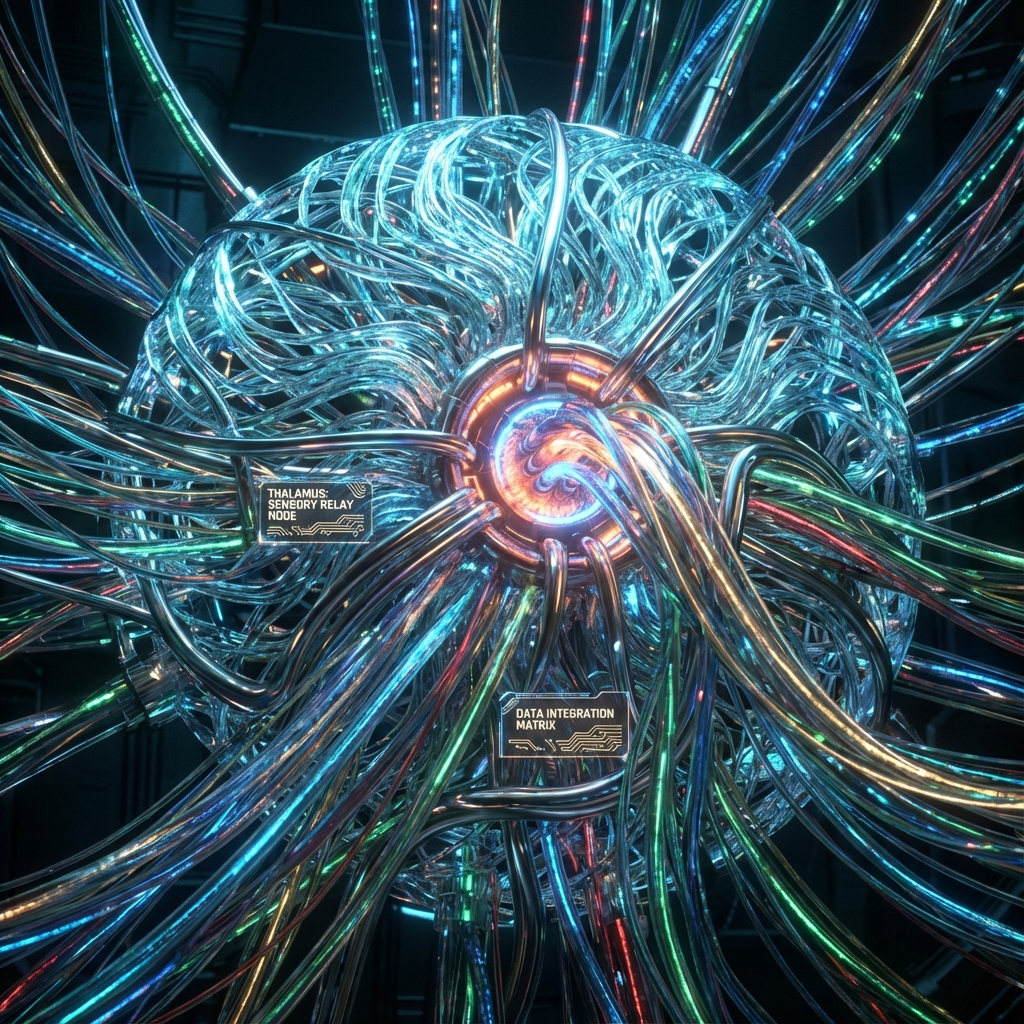
title: The Relay
subtitle: The Thalamus and the gate of consciousness.
book: Book 2
chapter_id: 13
read_time: 12 min
previous_chapter: ../book2/chapter12_hippocampus.html
next_chapter: ../book2/chapter14_dmn.html
meta_description: The Thalamus as the sensory hub.
The Grand Central Station
The Thalamus sits at the very center of the brain. Almost all sensory data (except smell) must pass through here to reach the Cortex.
It is the Gatekeeper.
The Gating Mechanism (TRN)
How does it block the noise?
The Thalamic Reticular Nucleus (TRN) wraps around the Thalamus like a shell. It is composed of inhibitory GABAergic neurons.
It is the Gain Control. It shuts down the relay neurons so you can focus on reading this sentence without feeling your shoes.
The Loop
Consciousness creates a standing wave between the Thalamus and Cortex:
1. Relay Nuclei (LGN/MGN): Pass raw sensory data up.
2. Higher Order Nuclei (Pulvinar/MD): Pass processed thoughts back and forth.
Pathology: If the loop falls out of sync (Theta instead of Gamma), we get Thalamocortical Dysrhythmia—the neurological basis of chronic pain, tinnitus, and perhaps psychosis.Removing the Filter
When we use psychedelics (acting on 5-HT2A receptors), the Thalamus is disinhibited. The TRN relaxes. The floodgates open. You see the music. You feel the color. The reducing valve, as Huxley called it, is removed.
The Inheritance of Perspective
Your reality is defined by what you attend to. The Thalamus is the aperture of your camera. Clinical depression often locks the aperture on the darkness. Training your attention (Meditation) is simply the practice of manually operating the Thalamic gate. You choose the view.