The Reset (Ketamine)

The Dissociative Anesthetic
Ketamine is not a "psychedelic" in the classical sense (like Psilocybin). It is a Dissociative Anesthetic.
At high doses (anesthesia), it disconnects the Thalamus from the Cortex. You are physically present but consciously absent.
At lower (sub-anesthetic) doses, it creates a unique state: The Observer Effect. You can view your trauma, your depression, and your life with zero emotional attachment.
It is the only legal psychedelic medicine currently FDA-approved (as Spravato/Esketamine).
The Disinhibition Hypothesis
How does an anesthetic wake up a depressed brain?
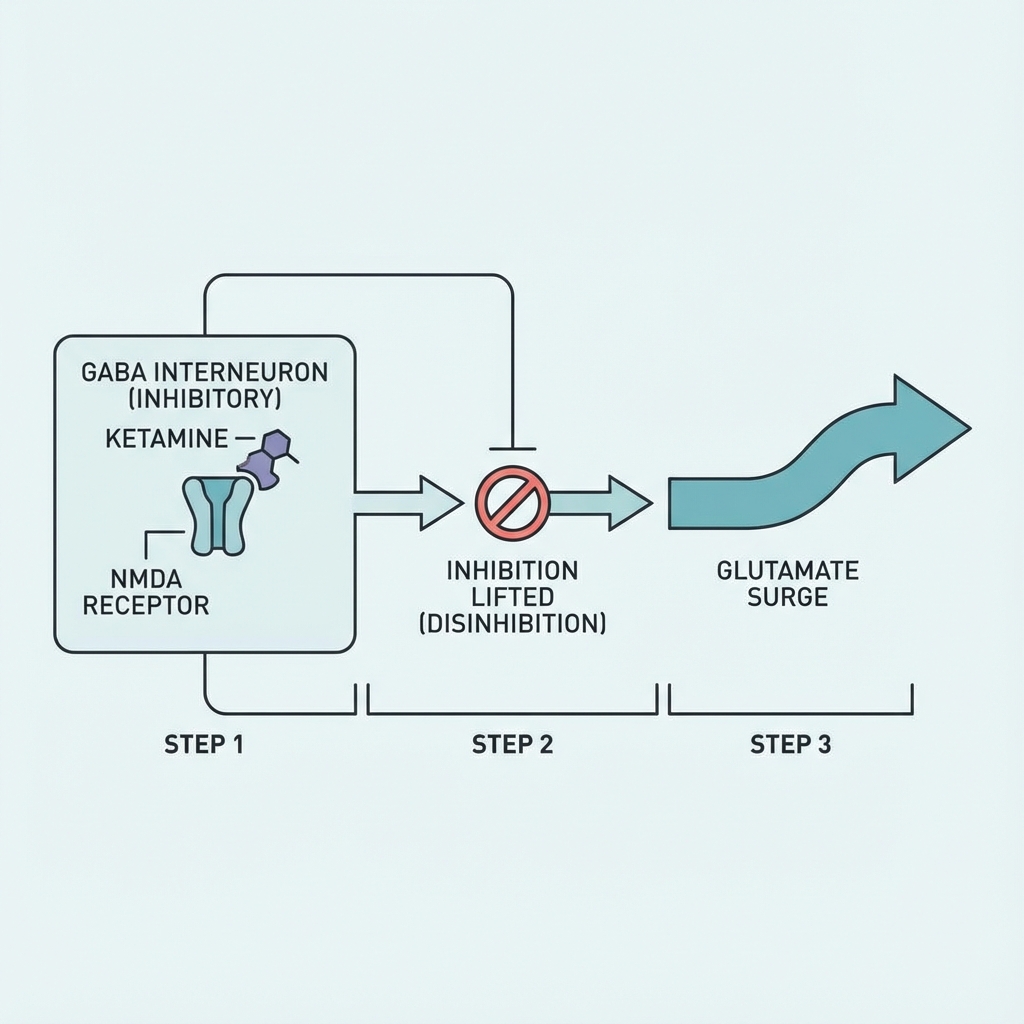
Ketamine is an NMDA Receptor Antagonist. It blocks the NMDA receptor.
Crucially, it preferentially blocks these receptors on GABA Interneurons (the brakes).
- Step 1: Ketamine blocks the GABA neuron.
- Step 2: The "Brakes" are cut.
- Step 3: The Glutamate neurons (the gas) fire a massive surge.
- Step 4: This "Glutamate Burst" triggers rapid BDNF release and synaptogenesis.
The Plasticity Window
Unlike daily pills, Ketamine is an event.
The drug leaves the system in roughly 3 hours (half-life ~2.5h).
However, the Neuroplastic Window remains open for 24-72 hours.
During this time, the brain is "soft." Old habits can be broken; new patterns can be formed.
Critical Insight: The medicine does not do the work. The medicine enables* the work. If you take Ketamine and return to a toxic environment, you will simply re-encode the toxicity.The Inheritance of Perspective
Sometimes the knots in the rope are too tight to untie with logic. You must dissolve the rope itself. Ketamine provides a brief holiday from the "Self." In that silence, you can remember who you were before the world told you who to be.
---
[!WARNING]
Clinical Context: Safety Protocol
>
1. Bladder Toxicity: Chronic, high-dose use (recreational "K-Hole") causes Ketamine Cystitis—permanent scarring of the bladder wall. Therapeutic use is spaced (weekly/monthly) specifically to avoid this.
2. Addiction Potential: Unlike Psilocybin (which has anti-addictive properties), Ketamine has a moderate abuse potential (Dopaminergic activity).
3. Contraindications: High blood pressure (it is a sympathomimetic), History of Psychosis, or Active Mania.
4. Supervision: Due to dissociation (falling risk) and blood pressure spikes, medical monitoring is standard.