Shiva's Prasad
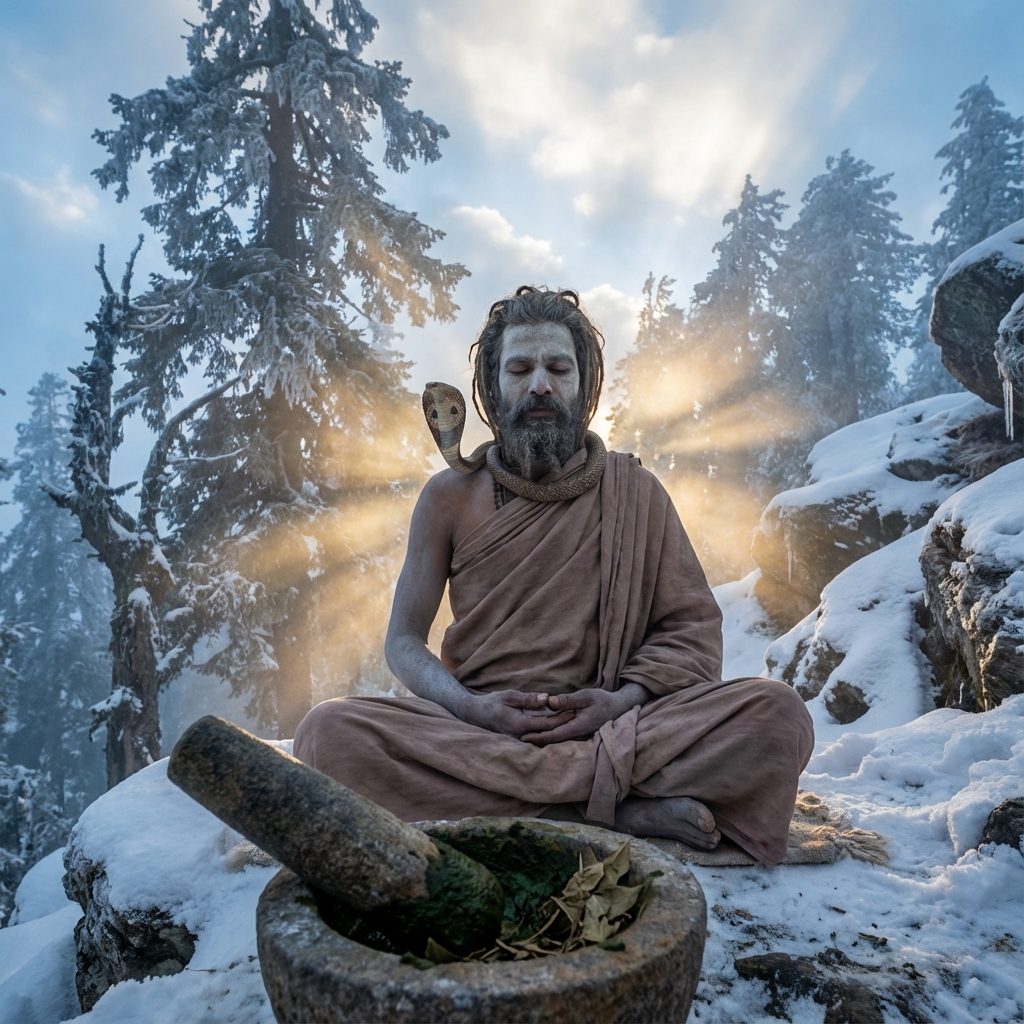
The Five Kingdoms of Herbs
References to cannabis in India are as old as the scriptures themselves. In the Atharvaveda (Book 11, Hymn 6, Verse 15), compiled c. 1500 BCE, the plant is listed as one of the five sacred plants of the subcontinent:
"To the five kingdoms of the plants which Soma rules as Lord we speak; the darbha, hemp, and barley, saha and power-glory (bhang), all these deliver us from woe."
It is classified as a "Liberator" (Mukti-dayaka), a source of happiness (Ananda-kanda), and a victory-giver (Vijaya). Before it was a drug, it was a deity.
The Three Forms: Bhang, Ganja, Charas
To understand the Indian context, one must distinguish the form, as the preparation dictates the effect (and the caste of the user).
1. Bhang (The Leaves): The male and female leaves are ground into a paste with milk, ghee, almonds, and spices (cardamom, saffron, rose water). This is Oral/Cooling. It is socially acceptable, used in festivals (Holi/Shivaratri), and considered a mild digestive and sleep aid. It is the "Beer" of the subcontinent.
2. Ganja (The Flowering Tops): The unfertilized female flowers (Sinsemilla). This is Smoked/Heating. It is stronger and more psychoactive. Historically associated with Sadhus and laborers to endure physical hardship.
3. Charas (The Resin): The pure resin rubbed by hand from the live plant. This is the Gold Standard. It is potent, cerebral, and intense. This is the sacrament of the ascetic elite (the Naga Babas).
The Ayurvedic Pharmacology: Visha vs. Amrita
Ayurveda (The Science of Life) classifies cannabis with extreme precision. It is not a "safe" herb like Tulsi. It is a Upavisha (sub-poison). It acts as a poison or a nectar depending on Yukti (logic of usage).
Rasa (Taste): Bitter (Tikta) and Pungent (Katu*). Virya (Potency): Heating (Ushna). Crucial distinction: Despite the "chill" vibe, cannabis increases body heat and metabolic fire (Agni). This is why Bhang is always mixed with Cooling* agents like milk, rose, and fennel—to balance the heating potency. Guna (Qualities): Light (Laghu), Sharp (Tikshna), and Drying (Ruksha*). Prabhav (Special Effect): Madakari* (Intoxicating/Hypnotic).The wise physician uses it to treat glaucoma, nervous system disorders, and severe pain. The fool uses it to increase Tamas (lethargy).
The Naga Babas: The Warriors of the Void
The living custodians of this tradition are the Naga Babas (Naked Yogis). They are Digambara (sky-clad), rubbing their bodies with the ash of the cremation ground (Vibhuti) to signify the death of the ego.
For the Naga, the Chillum (clay pipe) is not a recreational device. It is the form of Shiva himself.
- The clay pipe represents the body of Shiva.
- The fire is the transforming Shakti.
Before smoking, they invoke the deity with a guttural roar: "Alakh Niranjan!" (The Spotless Void) or "Jai Mahakal!" (Victory to Great Time/Death). The smoke is drawn deep into the lungs to arrest the fluctuations of the mind (Chitta Vritti Nirodha).
The Myth of Halahala: Why Shiva Smokes
Why does the Lord of Yoga need an herb?
The Puranas tell of the Samudra Manthan (Churning of the Ocean). When the cosmic poison (Halahala) emerged, threatening to consume existence, Shiva drank it to save the world. It turned his throat blue (Neelakantha).
The immense heat of the poison caused him agony. The gods offered him Bhang and Datura (another potent psychoactive) to cool the fire. The intoxication allowed him to withdraw his consciousness from the burning throat and return to the Kailasha of his inner peace.
Thus, we consume not to escape life, but to cool the heat of worldly suffering. The world is the Halahala; the Sacrament is the cooling balm that allows us to witness the fire without being consumed by it.